
Best Mattress for Heavy People: Support, Durability, and Cooling That Actually Lasts
Most mattresses are engineered around average body weights. If you’re a heavier sleeper, that matters—because what feels “supportive” in a showroom can soften, sag, and lose alignment much faster under higher load.
When a mattress fails under weight, it’s not just an early replacement problem. It can quietly create:
- Lower-back pain from hip sink
- Hip and shoulder pain from pressure buildup
- Overheating from deeper foam compression
- Edge collapse that shrinks usable space
- Restless sleep from micro-adjustments all night
This guide breaks down what actually works for heavy sleepers, including firmness mapped to weight + sleep position, what prevents sagging, what to demand in materials, and how to choose if you’re 300–400+ lb or a heavy couple.
What Counts as “Heavy” for Mattress Performance
For mattress performance, weight matters more than height or BMI because weight determines compression, foam fatigue, and coil stress.
Use these practical categories:
- Average: 150–220 lb
- Heavy: 220–300 lb
- Very Heavy: 300–400 lb+
Once you’re over ~220 lb, the mattress is exposed to:
- Deeper compression (you “reach” the support core faster)
- Faster foam softening (comfort layers break down earlier)
- Higher stress on edges (sitting + getting in/out becomes a failure point)
Why Standard Mattresses Fail for Heavy People
If you’re unsure how mattress construction affects support and longevity, start with our Mattress Buying Guide.
Most failures happen in the same predictable places:
1) Comfort Layers “Bottom Out”
Thin comfort layers feel okay at first, then you hit the firmer core too quickly. That creates pressure points and tossing.
2) Low-Density Foams Soften Early
This is the most common failure under higher weight. Once the top layers soften, your spine starts compensating nightly.
3) Midsection Support Collapses
Heavy sleepers load the midsection more. If the center support is weak, hips sink → spine arches → morning back pain.
Sagging under higher weight is a common cause of lower-back pain, which we explain in more detail in our best mattress for back pain guide.
4) Edges Collapse
Edge collapse makes a queen feel smaller and causes instability during transfers.
Important: The solution is not “buy the firmest mattress.”
The solution is buy the right construction (strong support core + stable transition layers + durable comfort layers).
Best Mattress Firmness for Heavy People (Quantified)
If firmness numbers feel confusing, our mattress firmness guide breaks down how different firmness levels actually feel under weight.
Use a 1–10 firmness scale, not labels like “plush” or “luxury firm.”
Best overall firmness range
Most heavy sleepers do best at: 6.5–7.5/10
This range prevents bottoming out while still giving enough cushioning to avoid joint pressure.
- Too soft → hips sink → alignment breaks → back pain
- Too firm → pressure builds → shoulder/hip pain (especially side sleepers)
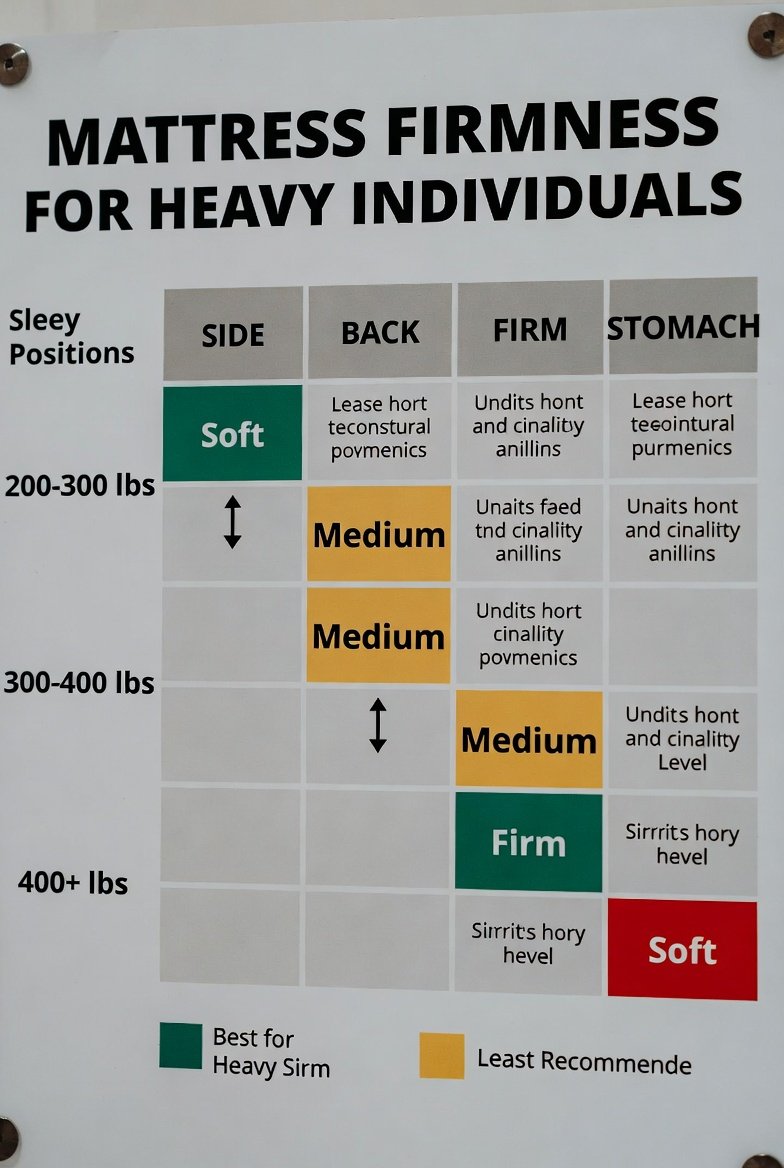
Firmness by Weight × Sleep Position
Sleep Position | 220–300 lb | 300–400+ lb |
Side sleeper | 6.5–7/10 | 7–7.5/10 + thicker comfort layers |
Back sleeper | 7–7.5/10 | 7.5–8/10 |
Stomach sleeper | 7.5/10 | Firm hybrid only (minimal sink) |
The “Non-Negotiables” Checklist for Heavy Sleepers
If you want a mattress for heavy people that truly holds up, prioritize these in this order:
1) A Support Core That Carries Weight (Not Just Soft Foam)
Heavy sleepers need a core that resists collapse. That usually means:
- A robust coil system, or
- A dense, resilient support material that doesn’t deform easily
2) Strong Transition Layers
Transition layers stop you from “dropping” into the core. Without them, even a firm bed can feel unstable.
3) Durable Comfort Layers
Comfort layers must cushion joints without softening fast. Under higher weight, this matters more than “how it feels in the first 5 minutes.”
4) Edge Reinforcement
Edges must hold up under sitting and shared sleeping. Weak edges are an early fail point for heavy sleepers.
5) Cooling That Works Under Compression
Heavier bodies compress foam more, which reduces airflow. Cooling must be structural, not just a “cool cover.”
Best Mattress Types for Heavy People
1) Hybrid Mattresses: Best Overall for Most Heavy Sleepers
Hybrids combine a coil support core with comfort layers.
Why hybrids tend to win under higher weight:
- Coils carry load better than foam cores
- Alignment holds longer over time
- Airflow is better (cooler for heavy sleepers)
- Edge support is typically stronger
Best for: most heavy sleepers, heavy couples, long-term use, hot sleepers
2) Latex Mattresses: Excellent for Very Heavy Sleepers
Latex is naturally dense and resilient, which helps it resist long-term compression.
Why latex works well for heavier bodies:
- “Pushback” support without deep sink
- Strong durability profile
- Often sleeps cooler than dense foam
Trade-off: latex can feel bouncier and is often pricier.
Best for: 300–400+ lb sleepers, hot sleepers, combination sleepers
3) Memory Foam: Use With Caution
Foam can work for heavy sleepers only if the build is strong enough.
What heavy sleepers should require in foam builds:
- Stable transition layers (to prevent bottoming out)
- A support core that doesn’t deform easily
- Comfort layers that don’t soften quickly
Big risk: budget foam tends to sag fastest under high load.
Best for: heavy side sleepers who need more pressure relief—only if durability specs are strong
Coil Strength and Build Clues That Matter (Without Brand Names)
Most people look at marketing. Heavy sleepers must look at structure.
Coils
- Stronger steel support generally feels more stable over time
- Pocketed coils distribute weight more evenly
- Weak coil systems lose tension faster under heavier loads
If a mattress gives no meaningful build transparency, treat that as a red flag.
Cooling for Heavy Sleepers (What Actually Works)
Heavier bodies run warmer at night, and deeper compression can trap heat.
Cooling performance by type
Mattress Type | Cooling Performance for Heavy Sleepers |
Hybrid | ⭐⭐⭐⭐☆ (airflow through coil core) |
Latex | ⭐⭐⭐⭐☆ (temperature-neutral feel) |
Memory foam | ⭐⭐☆ (unless built for airflow) |
Cooling features that help most
- A breathable core (hybrid-style airflow)
- Materials that don’t “hug” too deeply
- A design that stays stable (less sink = less heat trap)
If you sleep hot: hybrids or latex builds are usually the safest under higher weight.
Edge Support Matters More Under Higher Weight
Edge collapse is common for heavy sleepers and heavy couples.
Strong edges help with:
- Sitting and transfers
- Getting in/out of bed
- Usable sleep surface (especially queen)
- Long-term durability
If edges feel unstable early, it usually gets worse—not better.
Longevity and Warranty: What Heavy Sleepers Should Expect
Heavy sleepers load a mattress more intensely. Lifespan differs by build.
Realistic lifespan under heavier weight
- Foam: 4–6 years
- Hybrid: 7–10 years
- Latex: 8–12 years
Warranty minimum standards
- A clear sag policy (stricter is better)
- Clear language on what is covered
- Avoid vague “normal wear” wording that blocks claims
Heavy Couples: Special Considerations
Two heavy sleepers sharing a bed increases compression dramatically.
What heavy couples should prioritize:
- Strong edge reinforcement
- Stable center support (to prevent the “valley” effect)
- Bigger size if possible (queen minimum, king ideal)
- Construction that resists sag long-term (hybrid/latex)
If weights differ a lot: consider a build that reduces mismatch (stability + adaptable comfort).
Adjustable Bases and Heavy Sleepers
Adjustable bases can help with:
- Pressure redistribution
- Reduced lumbar strain
- Breathing comfort
But: an adjustable base cannot fix a mattress that’s too soft or unstable.
Also check:
- Base weight limits
- Combined load capacity (base + mattress + sleepers)
Common Mistakes Heavy Sleepers Make
- Choosing “medium” foam because it feels nice initially
- Prioritizing softness over structure
- Ignoring edge support
- Skipping cooling requirements
- Buying with no real trial
Final Verdict: Best Mattress for Heavy People
The best mattress for heavy people:
- Supports 220–400+ lb bodies without collapsing
- Sits in the 6.5–7.5/10 firmness zone for most sleepers
- Uses a structure that resists long-term sag (often hybrid or latex)
- Has strong midsection and edge stability
- Sleeps cool enough for deeper compression realities
- Comes with a real sleep trial and clear warranty
For most heavy sleepers, a medium-firm to firm hybrid with strong edge reinforcement is the safest, longest-lasting choice.
For 300–400+ lb sleepers, latex or heavy-duty hybrid builds are often the most stable long-term.
FAQs
What firmness is best for heavy people?
Most heavy sleepers do best in the 6.5–7.5/10 range, adjusted by sleep position.
Are foam mattresses bad for heavy sleepers?
Low-density or poorly built foam tends to sag faster. Stronger builds can work, but foam often wears sooner under higher load.
Do heavy people need special mattresses?
They need a mattress built with stronger structure and durability. Many “standard” mattresses fail early under higher weight.
Is edge support important for heavy sleepers?
Yes—edge stability affects safety, usability, and long-term durability.
How long should a mattress last for heavy people?
Foam often lasts 4–6 years, hybrids 7–10 years, latex 8–12 years, depending on build and use.