
Mattress Firmness Guide: How Firm Should Your Mattress Be?
Mattress firmness is one of those things everyone thinks they understand… until they buy the wrong one.
Some people assume firmer = better for back pain. Others assume soft = comfort. And many trust the label that says “medium” like it’s a universal standard.
It isn’t.
Even reputable reviewers note that mattress firmness isn’t standardized across brands—one company’s “medium” can feel like another company’s “firm.”
So the goal isn’t to find a magic number. The goal is to find the firmness range that gives your body:
neutral spine alignment + pressure relief + stable support.
This guide gives you a simple system to choose firmness based on sleep position, body weight, and mattress type, plus a quick at-home test so you can tell if a mattress is too soft or too firm after real sleep—not a 2-minute showroom lie.
Firmness vs Support (The Confusion That Causes Bad Sleep)
Let’s separate two things people mix up:
- Firmness = surface feel (how hard/soft it feels on top)
- Support = spinal alignment (whether your body stays neutral all night)
A mattress can feel soft but still be supportive.
A mattress can feel firm and still be wrong if it creates pressure points or forces your spine out of neutral.
This is why “I bought a firm bed and my back still hurts” happens.
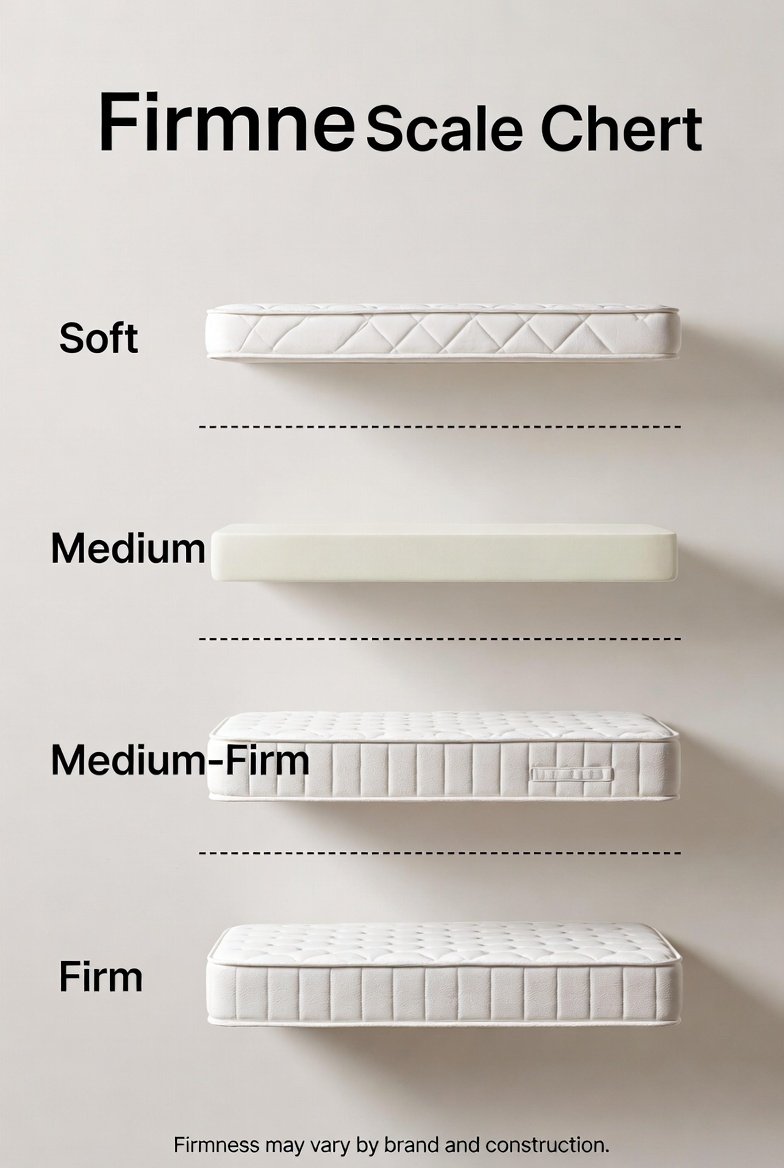
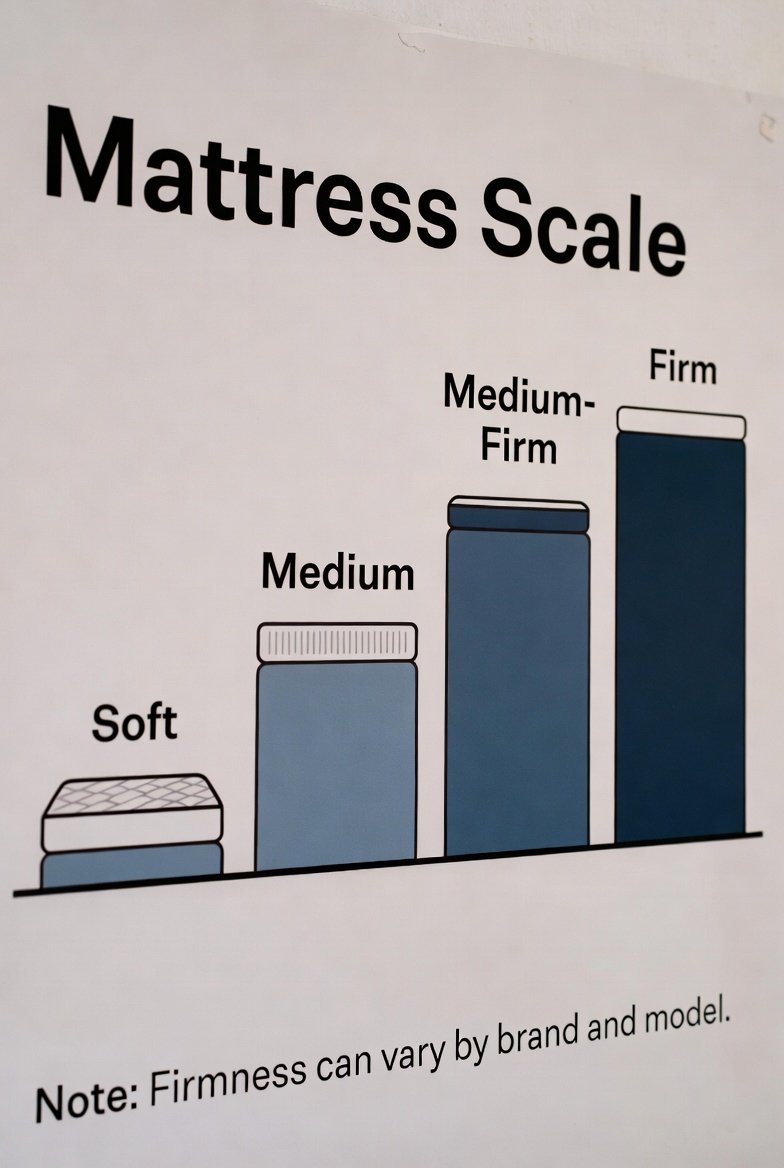
The Mattress Firmness Scale (And Why It’s Not Universal)
Many brands and review sites use a 1–10 scale, but there’s no universal measurement standard.
So instead of obsessing over numbers, use functional categories:
Soft
- Deep contouring / more sink
- Best for lighter side sleepers who need pressure relief
- Risk: can feel unstable for back/stomach sleepers
Medium
- Balanced cushion + support
- Best for many combo sleepers and average-weight side sleepers
- Risk: may still feel firm to lighter people
Medium-Firm
- More stable, less sink, still some cushion
- Often works well for back sleepers and couples
- Risk: may feel “too firm” for light side sleepers
Firm
- Flat, minimal sink
- Often works best for stomach sleepers and heavier bodies
- Risk: pressure points for side sleepers
Reality check: If a mattress feels “objectively wrong,” it’s usually wrong for your body and sleep style, not wrong for everyone.
The Fastest Way to Choose Firmness (30-Second Decision Rule)
Answer these three questions:
- Do you mostly sleep on your side, back, or stomach?
- Are you light (<130), average (130–230), or heavy (>230)? (rough bands)
- Do you wake up with pressure pain (shoulder/hip) or alignment pain (lower back)?
Then pick your starting range:
- Pressure pain (shoulder/hip numbness) → you’re likely too firm
- Alignment pain (lower back tightness / hips sinking) → you’re likely too soft
- No pain but restless turning → firmness or temperature could be off
This logic tracks with how body weight changes sinkage and pressure distribution across positions.
How Body Weight Changes Firmness Feel (This Matters More Than People Admit)
Your body weight changes how much you compress comfort layers and the support core:
Lighter Sleepers (Under ~130 lbs)
- Feel mattresses firmer
- Need more pressure relief
- Often do better with medium-soft to medium
Average Sleepers (~130–230 lbs)
- Feel firmness closer to “as designed”
- Often do well with medium to medium-firm
Heavier Sleepers (Over ~230 lbs)
- Sink deeper; mattresses feel softer
- Need stronger support cores and often medium-firm to firm
- Hybrids/latex tend to hold structure better under load
Firmness by Sleeping Position (The Practical Map)
Side Sleepers
Side sleeping concentrates pressure on one shoulder and hip.
- Best starting range: medium-soft to medium
- Too firm = shoulder/hip pain or numbness
- Too soft = spine curves downward, lower-back strain
Back Sleepers
Back sleeping needs balance so hips don’t sink too far.
- Best starting range: medium to medium-firm
- Too soft = hips dip → lower back tightness
- Too firm = pressure around tailbone/upper back (less common)
Stomach Sleepers
Stomach sleepers load the center of the mattress more and are prone to sag-related alignment issues.
- Best starting range: medium-firm to firm
- Too soft = pelvis sinks → spinal arching
Combination Sleepers
You need adaptability and ease of movement.
- Best starting range: medium to medium-firm (often hybrid)
Mattress Type Changes Firmness (Two “Mediums” Can Feel Totally Different)
Memory Foam
- Often feels softer than rated (more contouring)
- Great pressure relief
- Heavier sleepers can “bottom out” if the support core is weak
Hybrid
- Foam comfort + coil support
- More stable and consistent across body types
- Often the safest default for couples and combo sleepers
Innerspring
- Often feels firmer upfront
- Pressure relief depends heavily on comfort layers
- Can be bouncy (good for movement, bad for motion transfer)
Latex
- Buoyant, responsive, often feels firmer than foam
- Great durability and airflow
- Higher upfront cost
Consumer testing organizations emphasize that construction and measured firmness help compare beyond marketing labels.
One-Glance Firmness Selector (Save This)
Sleeper Type | Body Weight | Best Starting Firmness | Notes |
Side sleeper | Light | Medium-soft | prioritize pressure relief |
Side sleeper | Average | Medium | balance contour + support |
Side sleeper | Heavy | Medium-firm | avoid “bottoming out” |
Back sleeper | Light | Medium | too firm can feel harsh |
Back sleeper | Average | Medium-firm | stable hips, neutral spine |
Back sleeper | Heavy | Medium-firm → Firm | strong support core needed |
Stomach sleeper | Any | Medium-firm → Firm | keep pelvis from sinking |
Couples (mixed) | Mixed | Medium-firm | consider split firmness |
Couples: The Most Common Firmness Problem (Mixed Bodies, One Mattress)
If one person is lighter and one is heavier, they experience the same bed differently.
Two practical options:
- Medium-firm hybrid (most forgiving middle ground)
- Split firmness (especially if one is a side sleeper and the other is a stomach sleeper)
Also: heat can increase sink and make the mattress feel softer. If one person sleeps hot, that can shift “feel” night to night.
How to Tell If Your Mattress Is Too Firm or Too Soft (At-Home Test)
Do this after 3–7 nights, not 3 minutes.
Too Firm Signs
- Shoulder/hip pain (side sleepers)
- Tingling/numbness in arms
- You wake up needing to stretch joints
Too Soft Signs
- Lower back tightness
- Hips feel “stuck” or sunk
- You feel like you’re climbing out of a hole
- You wake up more tired than expected
If you’re unsure, check alignment: lie on your side and have someone take a quick photo—your spine should look relatively straight (not curved like a banana).
Does Firmness Affect Pain?
Yes, but pain relief isn’t about “firm” as a blanket solution.
Research reviews commonly suggest medium-firm surfaces can reduce pain for some people with low-back pain—because it’s a balance of support and pressure distribution.
Limitation: pain has multiple causes, and a mattress isn’t medical care.
Does Mattress Firmness Change Over Time?
Yes.
- Softer beds often soften further
- Foam can soften with heat and use
- Hybrids/latex generally hold structure better (depends on build quality)
Durability matters because the “right firmness” on day 1 can become “too soft” over months if the materials degrade.
Final Verdict: How Firm Should Your Mattress Be?
The right firmness is the one that:
- keeps your spine neutral
- relieves pressure points
- matches your body weight
- matches your sleep position
- still feels good after weeks, not minutes
If you’re stuck between two choices, medium-firm is usually the safest starting point for most adults—especially couples and back sleepers—because it balances stability and comfort.
1-Line Decision Matrix:
Best all-around: Medium-firm hybrid • Best for light side sleepers: Medium/medium-soft • Best for stomach sleepers/heavier bodies: Firm with strong support core