
Best Mattress Under $1,000: Real Value Picks Without the Budget Traps
A $1,000 budget is the best value zone in the mattress market. Below this range, support and durability drop fast. Above it, you often pay for branding, luxury finishes, or showroom margins—not necessarily better sleep.
The goal isn’t “cheap.” The goal is lasting support + pressure relief + cooling, at a price that doesn’t punish you later.
In this Mattress Buying Guide, you’ll learn how to pick the best mattress under $1,000 based on sleep position, body weight, heat, couples use, and durability, plus how to avoid the budget traps that feel fine for 60 nights and collapse by year two.
What $1,000 Usually Buys You
At this price point, you can realistically expect:
- Support that holds alignment for most sleepers
- Pressure relief that fits common sleep positions
- Good motion control (important for couples)
- A real sleep trial (90 nights minimum)
- A real warranty (10 years is normal)
But usually not included (and that’s okay):
- Thick “luxury” pillow-tops
- Pure, thick natural latex slabs
- Hand-tufted showroom builds
If you chase luxury add-ons under $1,000, you often sacrifice foam density and core support, which matters more.
The Budget Mattress Scorecard (How to Judge Value Fast)
Your Core Rule
If you remember one thing, remember this:
Under $1,000, build quality matters more than “feel.”
Feel can be faked with soft top layers. Support and durability can’t.
Foam vs Hybrid Under $1,000: What Performs Best
Here’s the simple performance difference:
- Foam mattresses usually win on motion isolation and pressure relief
- Hybrid mattresses usually win on support longevity, cooling, and edge stability
Quick Performance Table
Feature | Foam | Hybrid | Latex-Blend |
Motion isolation | High | Medium–High | Medium |
Cooling | Medium | High | High |
Edge support | Medium–Low | High | Medium–High |
Durability under shared use | Medium | High | Medium–High |
Best for | Light sleepers, side sleepers | Most sleepers, couples, heavier bodies | Hot sleepers who dislike deep sink |
Budget reality: if you’re heavier, sleep hot, or share a bed, hybrid is usually the safer bet.
Firmness Under $1,000 (The “No-Regret Range”)
Use a 1–10 firmness scale
- Medium: 5–6/10
- Medium-firm: 6–7/10
Avoid extremes at this price:
- Very soft budget beds tend to use lower-density foams that soften quickly
- Very firm budget beds often lack comfort layers → pressure pain (especially side sleepers)
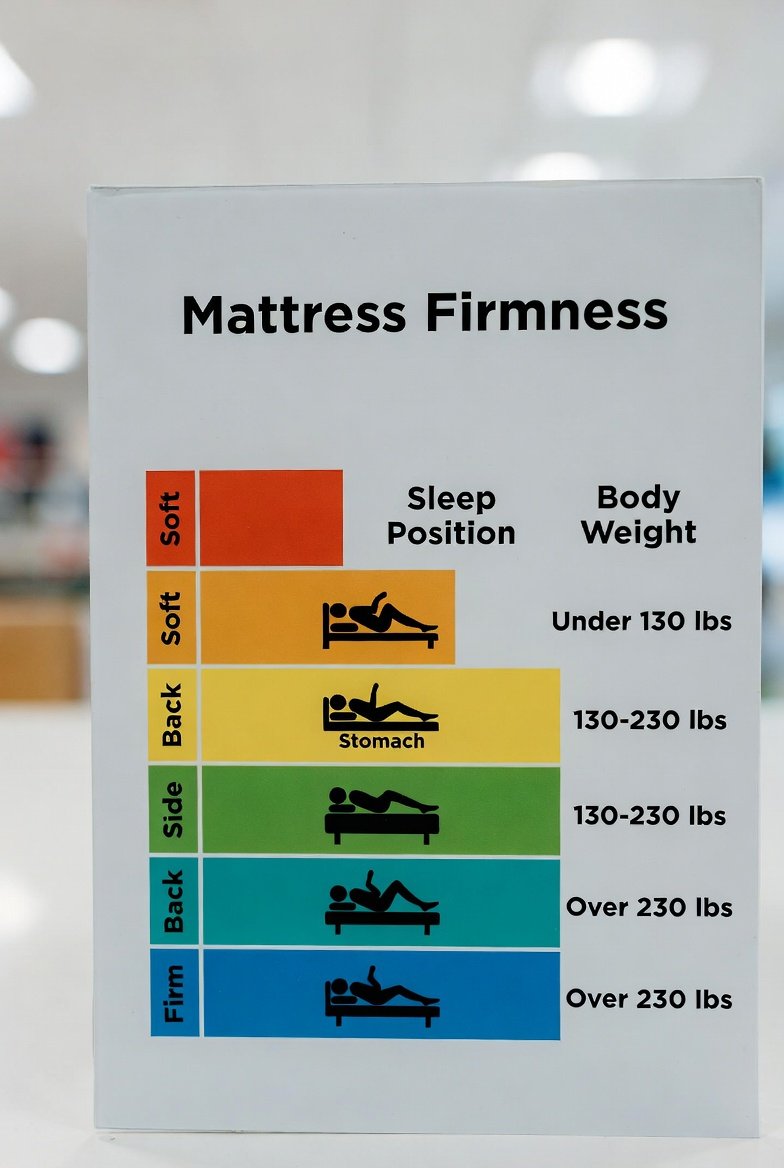
Firmness Sweet Spot by Sleep Position + Weight
Sleeper Type | <150 lb | 150–220 lb | >220 lb |
Side sleeper | 5/10 | 5.5–6/10 | 6–6.5/10 |
Back sleeper | 5.5/10 | 6–6.5/10 | 6.5–7/10 |
Stomach sleeper | 6/10 | 6.5–7/10 | Hybrid-only (firm-leaning) |
This one table prevents most budget mistakes.
Body Weight Changes Everything (Because Compression Changes Everything)
Weight categories
- Lightweight: <150 lb (mattresses feel firmer)
- Average: 150–220 lb (mattresses feel “as advertised”)
- Heavy: >220 lb (foams compress faster; support matters more)
Budget rule for heavier sleepers:
If you’re over 220 lb, prioritize strong core support and durability—hybrid tends to outperform foam under long-term load.
Cooling Under $1,000 (What’s Real, What’s Hype)
Hot sleepers can absolutely find a good mattress under $1,000—but you must choose the right construction, not just “cooling” labels.
Cooling features that actually help
- Airflow through the core (hybrids often do this better)
- Breathable surface + comfort layers
- Materials that don’t trap heat aggressively
Cooling features that are often oversold
- “Cooling cover” alone (nice, but not enough)
- “Gel foam” with a dense, non-breathable base (can still trap heat)
If you sleep hot: a hybrid build is usually your safest play under $1,000.
Motion Isolation Under $1,000 (Couples + Light Sleepers)
If one partner moves and the other wakes up, you don’t have a comfort problem—you have a motion problem.
Best budget setups for motion control
- Foam-forward surfaces that absorb vibration
- Designs with thicker transition layers to stop movement from reaching the core
Couples note: if durability matters too (it does), look for a build that balances motion control with support stability—often a hybrid with strong comfort layering.
Edge Support (The “Queen That Feels Like a Full” Problem)
Weak edges shrink your usable sleep space.
Edge support matters for:
- Couples
- Anyone who sits on the bed edge
- Smaller sizes (full/queen)
- Long-term structure
Budget truth: edge collapse is one of the earliest failure points in cheap builds.
Best Mattress Under $1,000 by Sleep Position
Best for Side Sleepers
What you need: shoulder/hip pressure relief without losing alignment.
Aim for: 5–6/10 feel, foam or hybrid with real comfort layers.
Avoid: firm budget beds with thin tops.
Best for Back Sleepers
What you need: lumbar support and stable midsection.
Aim for: 6–7/10 feel, medium-firm with strong core support.
Watch for: early sagging in the center.
Best for Stomach Sleepers
What you need: hips lifted, minimal sink.
Aim for: firm-leaning surface with thin comfort layers.
Best bet under $1,000: usually hybrid.
Sleep Trial + Warranty: Minimum Standards at This Price
What’s acceptable
- Trial: 90 nights minimum (120 is better)
- Warranty: 10 years
- Sag policy: the stricter the better (avoid vague language)
Avoid
- No trial
- Store-credit-only returns
- Unclear warranty terms
- “Final sale” mattresses marketed as “budget wins”
A trial isn’t a bonus. Under $1,000, it’s protection.
Foam vs Hybrid Over Time (What Happens After Year 3)
Common pattern:
- Foam builds are more likely to show earlier impressions, especially with two sleepers or higher weight
- Hybrid builds often retain alignment longer because the support core resists collapse better
If longevity is your priority under $1,000, hybrid usually wins.
How to Stretch a $1,000 Budget Further
Most reliable ways to get better value:
- Skip pillow-tops and “luxury height” gimmicks
- Choose build quality over thickness
- Buy with a real trial window
- Time purchases around major sale windows (when available)
- Don’t overspend on “cooling covers” if the core traps heat
A well-chosen $900 mattress beats a bad $1,400 mattress every time.
Final Verdict: Best Mattress Under $1,000
The best mattress under $1,000:
- Lives in the 5.5–6.5/10 firmness zone for most sleepers
- Matches your sleep position and body weight
- Uses a build that doesn’t collapse early (especially under two sleepers)
- Includes a real sleep trial and a clear warranty
- Avoids “luxury fluff” that steals budget from support materials
For most people, a budget hybrid is the safest value pick under $1,000 because it balances comfort, cooling, and durability better across different bodies and sleep styles.
FAQs
Is $1,000 enough for a good mattress?
Yes. It’s one of the strongest value tiers if you choose based on build quality, not marketing.
Is foam or hybrid better under $1,000?
Hybrids usually last longer and work better for mixed body types and hot sleepers. Foam can be excellent for motion isolation and pressure relief.
How long will a budget mattress last?
Many foam options last around 5–7 years, while stronger hybrid builds often last 7–9 years, depending on materials and use.
Are cheap mattresses bad for your back?
Not automatically. They’re bad if they lack support or soften quickly, causing misalignment.
Should I buy a mattress online or in-store?
Online often provides better value and stronger trials, but the key is the trial + warranty terms—not where you buy.